

Zero Liquid Discharge Plant (ZLD Plant) is markedly different from other water filtration systems. While other systems focus on removing contaminants from wastewater, ZLD Plant recovers up to 95% of water from the contaminants, reducing them into a solid cake for disposal. ZLD faces the toughest filtration process of all wastewater treatment processes because the challenge in recovery rises with the increasing concentration of water. Due to the compulsive demand for high efficiency, zero liquid discharge plant costs might entail a high initial investment. However, it significantly lowers the volume of waste, and thus drastically cuts the waste management costs over a period of time. Here are 4 reasons why you should consider retrofitting your water treatment system
How a zero liquid discharge plant works
Zero liquid discharge plant is constructed by bringing together diverse water treatment technologies that can efficiently filter water as it moves towards concentration. However, it comprises a standard ZLD plant comprises a few basic components.
Zero Liquid Discharge Process Diagram
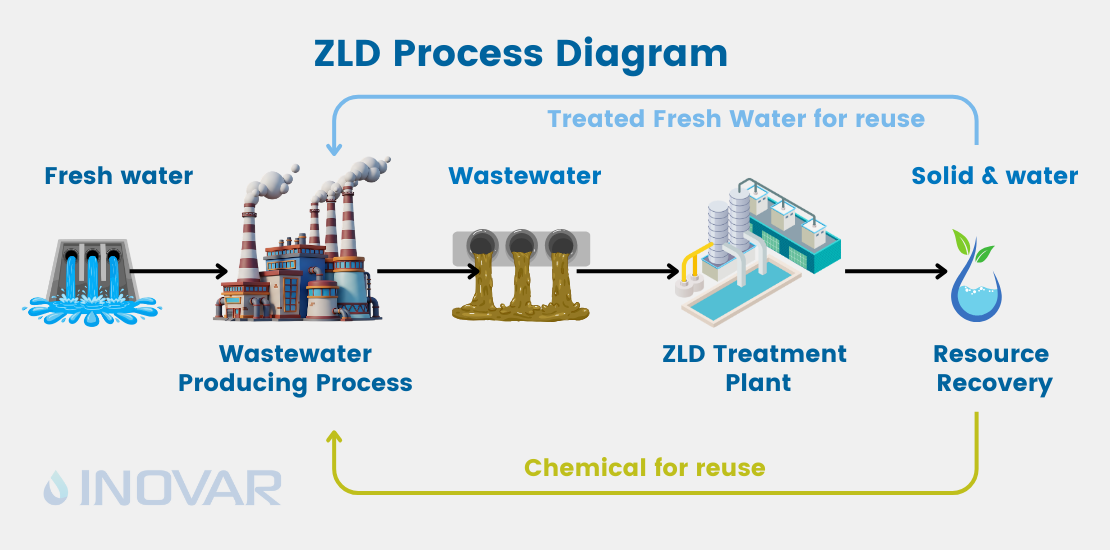
Components of a ZLD plant
Clarifier: The clarifier works to precipitate metals and silica out of the water and also remove its hardness.
Chemical feed: The chemical feed aids in precipitation, coagulation, or flocculation of suspended solids and metals in water.
Filter press: The filter press concentrates solid waste from the water after pretreatment.
Ultrafiltration system: Ultrafiltration system is used to remove the last remaining traces of suspended solids in the water, and to prevent scaling, corrosion or fouling further down the line of treatment.
Reverse Osmosis system: The RO is a subsystem in ZLD plant that removes suspended solids from the water in the primary stages of concentration.
Evaporator: The evaporator vaporizes excess water from the final waste concentration before It passes through the crystallizer.
Crystallizer: Boils out the last of the liquid from the waste, yielding a solid cake for disposal.
Despite these basic components, a zero liquid discharge system remains a highly custom process. Specific application requirements or needs of your facility might entail the addition of certain features or technologies to the plant.
Inovar offers customized and cost-effective ZLD Plant, designed after a close study of your specific requirements. We design our ZLD plants to minimize operating costs while keeping manpower requirements extremely low.
ZLD plants working principle
Pretreatment stage
Pretreatment works to rid the process water of simple suspended solids and other materials that might cause scaling or fouling in other treatment processes down the line.
Water enters a reaction tank where the suspended solids and metal are precipitated out. One to two reactors add certain chemicals to the water to combine the finer particles with the havier particles that settle down. Simple Aluminium-based coagulates are used in this process, including alum and polyaluminum chloride.
After coagulation, the water enters the flocculation chamber, where slow stirring forms visible, heavier, settleable particles. The flocculated material and water flow into the clarifier. Here, the water is circulated from the centre-out. Water rises up and overflows from the ides of the clarifier while solids settle at the bottom into a sludge basket. Rakes move these solids into a central cylindrical tube, where a slow mixing process takes place. Next, the sludge is pumped out of the bottom for de-watering.
In some cases, the clarifier stage is completely replaced by ultrafiltration systems. Wastewater is pumped directly from the source through the UF system (after chlorination) eliminating the entire clarifier filtration process.
The liquid that comes out of the clarifier or UF system is then filter-pressed into a solid material. This material has much lower amount of suspended solids and does not scale up the concentration treatment process.
Concentration stage
After pretreatment, operators concentrate the process water using reverse osmosis, electrodialysis, or brine concentrators. Efficient pretreatment of water is essential when using an RO system because untreated water will quickly foul the membranes. On the other hand, Brine concentrators are able to handle a much higher salt content than RO. Operators use electrodialysis together with RO when they need extremely high recovery rates.
These systems work together to increase the sanity of the brine solution and extract between 60%-80% of the water from it.
Crystallization
After the concentration of the process water, the resultant solution moves closer to yielding a solid cake in the process of crystallization. First, the solution enters an evaporator to remove the water. We collect the evaporated water for reuse. At this stage, we add acids to the concentrate to neutralize the solution and prevent scaling damage to the heat exchangers. The system removes oxygen, nitrogen, carbon dioxide, and other non‑condensable gases through deaeration at this stage.
The crystallizer receives the remaining waste from the evaporator and boils the concentrate until all water evaporates and the impurities form solid crystals.
Solid waste treatment
After the evaporation operation, the solid waste undergoes further water removal through a filter or belt press… The press receives the sludge and runs it between a pair of belts that squeeze out the water. Afterward, the system drops the remaining solid cake into the hopper for responsible disposal.
Zero liquid discharge plant benefits
- Low volume of waste and reduced waste management costs
- On-site water recycling, reducing water acquisition costs
- Improved compliance with waste disposal and water quality norms
- Recovery of valuable resources such as salts for resue
Conclusion
Zero Liquid Discharge plant is a highly customizable solution. Features or technologies added to the system affect the zero liquid discharge plant costs. As an expert in the design and manufacture of high-performance and cost-effective ZLD plants, Inovar can become your reliable partner for zero liquid discharge systems.
Inovar ZLD Plants are designed to minimize operating costs while having little to no impact on the manpower required for their operation.
Inovar is a technology-focused company that offers end-to-end water treatment solutions for facilities of any size. Our services include feasibility studies, engineering design, manufacturing, and installation. We support all our products with Annual Maintenance Contracts, helping you reduce the operating costs of your ZLD plant.
Zero Liquid Discharge Process
zero liquid discharge system
ZLD Plant