
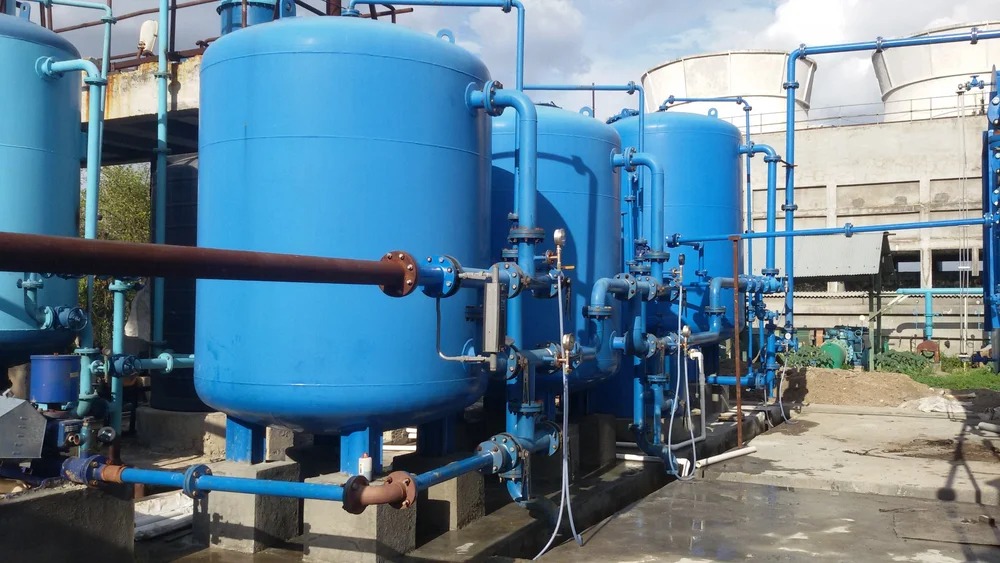
Demineralization Plant
Even trace minerals can corrode systems, interfere with production or ruin a batch. Demineralization Plant (DM Plant) from Inovar ensure ultra-pure water consistently and reliably. While standard DM water plant systems are often sized generically, they don’t account for the actual ionic composition of your input water. That leads to frequent resin exhaustion, low throughput, and poor output quality.


What do we do differently?
- We analyze your feed water’s ionic profile, not just TDS.
- We select resin types and regeneration cycles based on actual ionic load.
- Inovar design customize bed configurations dual, mixed, or counter-current based on application.
- We automate regeneration cycles for consistency and reduce human error.
- We build compact skids that simplify installation and maintenance.
What You Get with Inovar

Ultra-pure water with conductivity as below 0.1 µS/cm

Removal of calcium, magnesium, sodium, chloride, sulfate, nitrate, and more

High-capacity resins for long service cycles and fewer regenerations

Corrosion-resistant, non-reactive piping and valves

Smart control panel with regeneration alerts and data logs

Quick commissioning and minimal manual intervention
Best suited for

Metal finishing and electroplating industry

Electronics manufacturing

Semi- conductor automobiles

FMCG & Breweries

Pharmaceutical
After Installation, We Stay Involved
1-Year AMC
to ensure plant performance
Regeneration salts
and chemicals tailored to your setup
On-call
technical assistance and log analysis
Optional O&M
with trained technicians
Plant Performance
tracking and recharging schedule optimization
Upgrading or Troubleshooting an Existing DM Water Plant System?
We conduct a resin life-cycle audit, water chemistry review and system diagnostics to enhance performance and reduce cost per litre.
Since 2019, Inovar has been leading the way in DM Plant
- Inovar design with data, not assumptions
- We engineer for long-term performance, not just installation.
- We don’t cut corners to stay cheap.
- Inovar prioritize total cost of ownership (TCO), not just CapEx.
- We care what happens after handover.
Frequently Asked Questions
What is a Demineralization Plant (DM Plant)?
A Demineralization Plant (DM) is an ion exchange process that removes virtually all dissolved salts and minerals (ions) from water. It produces high-purity water, comparable to distilled water, but often more cost-effectively and at a larger scale. It is also known as a Deionization (DI) Plant.
How does a DM plant works?
A standard DM plant uses a two-step ion exchange process:
1. Cation Exchange: Raw water first passes through a strong acid cation exchange resin, which removes all positively charged ions (cations) like Calcium (Ca²⁺), Magnesium (Mg²⁺), and Sodium (Na⁺), replacing them with Hydrogen (H⁺) ions.
2. Anion Exchange: The water then passes through a strong base anion exchange resin, which removes all negatively charged ions (anions) like Chloride (Cl⁻), Sulfate (SO₄²⁻), and Bicarbonate (HCO₃⁻), replacing them with Hydroxyl (OH⁻) ions.
The released H⁺ and OH⁻ ions then combine to form pure water (H₂O).
What impurities does a DM plant remove?
A DM plant removes ionized inorganic minerals and salts, including:
• Cations: Calcium, Magnesium, Sodium, Potassium, Iron, Manganese.
• Anions: Bicarbonate, Chloride, Sulfate, Nitrate, Silica, Carbonate.
What is the key difference between DM and Reverse Osmosis (RO)?
| Feature | Demineralization (DM) | Reverse Osmosis (RO) |
|---|---|---|
| Process | Ion Exchange (Chemical) | Membrane Filtration (Physical) |
| Mechanism | Swaps ions (H⁺ for cations, OH⁻ for anions) | Pressurizes water through a semi-permeable membrane |
| TDS Removal | Very high (>99%), can produce water with <5 mg/L TDS. | High (95-99%), produces water with low TDS. |
| Silica Removal | Excellent. Anion resin effectively removes silica. | Moderate. Requires high rejection RO membranes. |
| TDS Removal | Very high (>99%), can produce water with <5 mg/L TDS. | High (95-99%), produces water with low TDS. |
| Primary Use | Producing ultra-high-purity water for critical processes. | High-purity water for general industrial use, often as a pre- treatment for DM. |
Difference Between "Two-Bed DM" plant vs. a "Mixed-Bed DM" plant?
• Two-Bed DM (Twin Bed): Features separate vessels for cation and anion exchange resins. It is efficient and easier to regenerate, producing high-purity water (conductivity ~1-5 µS/cm).
• Mixed-Bed DM (MB): Cation and anion resins are mixed together in a single vessel. This allows for a much more thorough ion exchange, producing the highest purity water (conductivity <0.1 µS/cm). Often used as a final polisher after a Two-Bed DM or RO system.
Which industries typically require a DM Plant?
DM plants are critical for industries where even minute levels of dissolved ions can cause product damage, scaling, or process failure:
• High-Pressure Boiler Feed Water: For power plants and process industries to prevent severe scaling and corrosion in boilers and turbines.
• Pharmaceuticals & Biotechnology: For Water for Injection (WFI) make-up and process water.
• Electronics & Semiconductor Manufacturing: For wafer cleaning and circuit fabrication.
• Automotive & Surface Treatment: For critical rinsing stages in electroplating and painting.
• Chemical & Petrochemical Processes: As a reactant or solvent
What does "Exhaustion" of a DM plant mean?
Do you offer Operation & Maintenance (O&M) support?
Absolutely. We offer comprehensive AMC packages that include:
• Periodic resin analysis and cleaning.
• Inspection and calibration of instruments.
• Supply of replacement resins and consumables.
• Troubleshooting and technical support.
What is the cost of a Demineralization Plant?
The cost depends on:
• Capacity & Flow Rate
• Inlet Water Quality (TDS level)
• Required Output Water Purity (Two-Bed vs. Mixed-Bed)
• Level of Automation (Manual vs. Fully Automatic)
• Materials of Construction (e.g., MSRL, LDPE, FRP, SS)
• We provide customized quotations after a detailed analysis of your requirements.
Why is a DM plant better than a water softener for my boiler?
A water softener only removes hardness (Calcium & Magnesium). It does not remove silica, alkalinity, or other dissolved solids. These remaining impurities can cause silica scaling and corrosion in high-pressure boilers, leading to catastrophic failure. A DM plant removes all dissolved ions, providing complete protection.