India is a rapidly emerging market for beer. Valued at $16.652 million in 2022, the Indian beer market is expected to grow at a CAGR of 9% over the next few years. However, the industry may soon find itself staring at a shortage of water.
How much water does beer production require?
All aspects of beer production require a considerably large amount of water. 90–95% of the beer itself is comprised of water. Producing one litre of beer requires seven litres of water. An average microbrewery might be brewing around 10,000 to 12,000 litres a month, which means it will be using close to 84,000 litres of water a month.
Take the example of Bengaluru, the pub capital of India, home to around 60 microbreweries. Drawing from those figures, the city's microbreweries use a very large volume of water purely for brewing — before accounting for the water required for washing, sterilizing, and cleaning machines, utensils and pipes, along with general-purpose water. Surveys have warned that Bengaluru has begun to face a growing water shortage.
How could treating brewery wastewater help?
Breweries around India are cutting down on their water use in beer manufacturing. Beyond that, recycling process water for general-purpose use — especially in pubs attached to microbreweries — could save considerable water over time. Studies show that 49% of water use in hotels and restaurants is for non-potable purposes. This water can be saved by proper recycling.
What are the challenges in brewery wastewater treatment?
Characteristics of the wastewater
Even though breweries use natural ingredients to produce beer, the processing makes wastewater dangerous and difficult to treat. The wastewater contains high levels of BOD, COD and total suspended solids:
- High BOD of more than 5,000 mg/L
- High COD of more than 3,000 mg/L
- Low pH levels
- High TSS, up to around 1,800 mg/L
- High levels of sugar and alcohol
- Solids that easily turn into sludge
Possibility of corrosion
Wastewater from breweries often contains high levels of acidity. This water can produce hydrogen sulfide gas, which mixes with water vapour to produce hydrogen sulphide that can corrode the tanks of the treatment plant if they are made from mild steel or even concrete. This leads to delays in water treatment and depreciation of the equipment over time.
Fluctuating water levels
The production level of the brewery may fluctuate depending on peak or low season and customer demand. This results in fluctuation of water available for treatment. The acidity and pH level in brewery wastewater could also vary with time. If pH levels increase, it could increase the amount of sludge that needs to be removed during treatment.
How is wastewater from breweries treated?
Dissolved air flotation
Dissolved air flotation is a water treatment technology that uses air to remove suspended solids from process water. Air is dissolved under pressure, and numerous small air bubbles are released into the process water at atmospheric pressure. The dissolved air bubbles adhere to the suspended solids and cause them to rise to the surface, where the solids can be skimmed away. Flocculation and coagulation are also used to assist flotation.
Moving Bed Biofilm Reactor technology
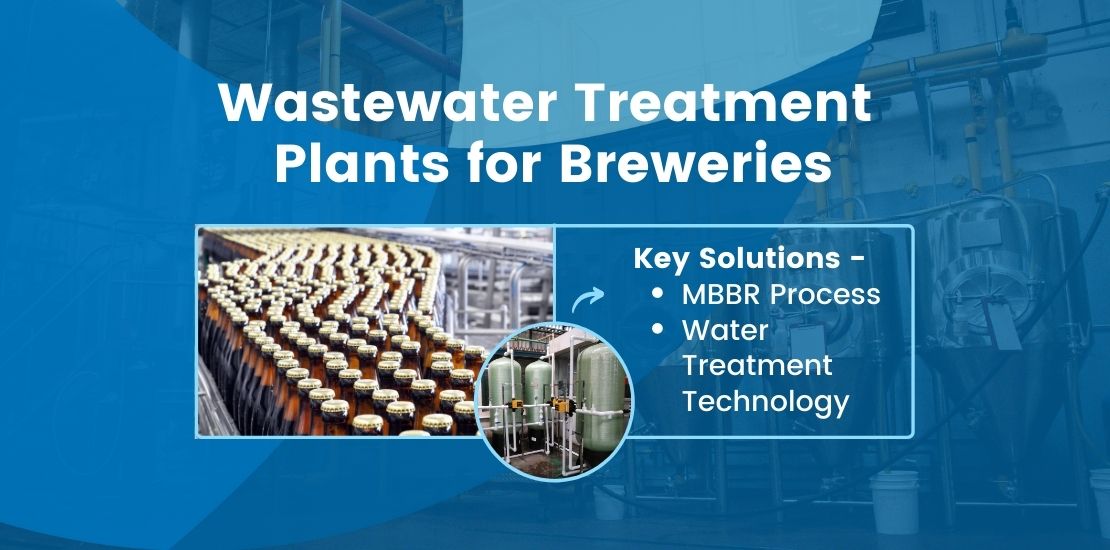
MBBR technology combines the conventional activated sludge process with biofilm media. It uses special floating plastic media inserted into the biological filtration tank. This media provides more space for microorganisms to grow on while reducing the footprint of the tank itself.
Conclusion
Given their high water consumption, breweries across India are vital to the nation's water conservation efforts. While breweries take measures to reduce their production water needs, treating and reusing water for non-potable purposes — especially in attached pubs in metros — could significantly improve water availability and reduce water procurement costs.
Apart from high-quality treatment of water, the availability of space for a wastewater treatment plant in breweries is a major concern. Inovar offers end-to-end solutions in wastewater treatment, from design to commissioning, working closely with the customer to provide customized plants that operate amid the toughest space constraints, along with cost-effective technology to eliminate effluent treatment odour.
Published 28 May 2025 by Inovar Engineering.
Talk to our engineers