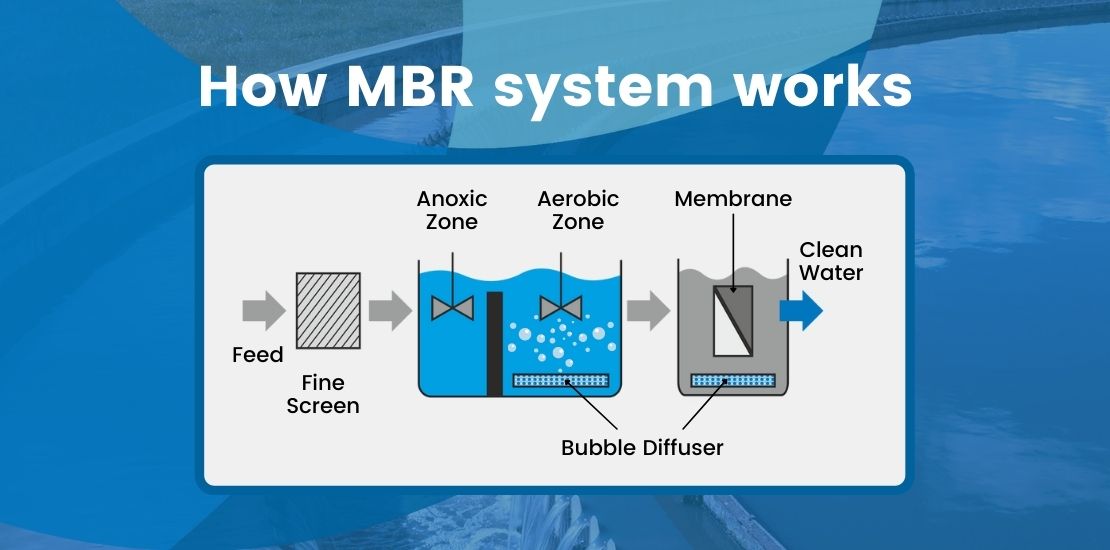
The Membrane Bioreactor (MBR) process is a mechanism used to separate the sludge that emerges during the filtration of biological waste in wastewater treatment. The MBR system is a combination of biological filtration and microfiltration or ultrafiltration processes. It is a much more efficient and shorter process than the conventional activated sludge mechanism.
In the traditional activated sludge process, the settling tank separates the sludge into solid and liquid, and the system then sends it for secondary clarification. The MBR system combines activated sludge treatment with solid-liquid separation using micro-porous membranes instead of traditional secondary clarification. In a standard setup, the MBR module is placed in a separate tank after the oxidation tank. The MBR modules can also be introduced directly into the oxidation tank — a compact system. The MBR system can be arranged in a variety of configurations.
Components of an MBR system
- Rotary influent screen
- Anoxic tank
- Aerobic tank
- Anaerobic tank
- MBR modules
- Air blowers
- Pump set for permeate suction
- Chemical dosing systems
- Cleaning tank for backwash
How MBR works, step by step
Step 1: the anoxic tank
The system screens the wastewater to remove large solids and then sends it into the anoxic tank. Here, a submersible mixer mixes the process water with mixed liquor returning from the MBR tank to obtain the desired level of denitrification. Without dissolved oxygen, the bacteria in the tank convert nitrate into nitrogen gas.
Step 2: the anaerobic tank
From the anoxic tank, the process water flows into the anaerobic tank. The anaerobic process triggers the discharge of phosphorus by microbes fuelling the anaerobic reaction.
Step 3: the aerobic tank
From the anaerobic tank, the process water flows into the aerobic tank. Here, oxygen is injected using air blowers and a diffused aeration system. The oxygen-rich environment aids in biologically oxidising organic material and ammoniacal nitrogen from process water. What remains is carbon dioxide, nitrate and water.
Step 4: the MBR membrane tank
The system sends the process water from the aerobic tank into the MBR tank for liquid-solid separation. Flat-sheet MBR membranes operate fully submerged in the mixed liquor inside the MBR tank. The membranes have a pore size of 0.04 micrometres and separate solids and microbes from activated sludge. The aeration system within the tank creates an upward flow of water and air flux. This prevents fouling of membranes and ensures up to 99% efficiency in the removal of suspended solids.
Advantages of the MBR system
- Higher efficiency
- Shorter hydraulic retention time
- Longer solid retention time
- Smaller footprint due to the absence of secondary clarifiers
- Suited for high-strength effluents
- Potential for simultaneous nitrification and denitrification at long solid retention times
Conclusion
The MBR system offers more efficiency and flexibility in water treatment than conventional systems. It is the critical component that allows an Inovar water treatment plant to have a smaller footprint. The MBR system can be configured in a number of ways and can be easily integrated into an existing system. Along with design, manufacturing and installation of new STPs, Inovar also provides consultancy and retrofitting services to upgrade existing plants.
Published 29 May 2025 by Inovar Engineering.
Talk to our engineers